


How Do Orcas Communicate? Understanding Calls, Clicks & Echolocation in the Salish Sea
Orca communication is one of the most fascinating parts of killer whale behavior. These highly social marine mammals use calls, whistles, clicks, and body movements to interact with one another and navigate their underwater environment.
Sound is especially important because visibility underwater can be limited. For orcas moving through the Salish Sea, hearing and producing sound can help with communication, orientation, and finding prey.
Here's what researchers know about the different sounds orcas make and what they may be used for.

The Main Types of Orca Sounds
Orcas produce several types of underwater sounds, commonly grouped into three broad categories:
Pulsed calls
Echolocation clicks
Whistles
These sounds can serve different purposes depending on the population, activity, and social context.
Researchers use underwater recordings and direct observations to study how vocal behavior relates to hunting, travelling, and social interactions.
Pulsed Calls: Social Communication
Pulsed calls are distinctive vocalizations frequently associated with social communication.
Different killer whale populations can have different vocal traditions. Groups may use recognizable repertoires of calls that are learned and maintained socially.
This is one example of what researchers describe as culture in killer whales: information and behavior can be learned from other members of the group and passed between generations.
Orca communication is complex, but researchers should be cautious about translating a particular call into a specific human-style word or sentence.
Echolocation Clicks
Orcas can use echolocation to gather information about their surroundings.
They produce clicks and listen to the returning echoes. Those echoes provide information about objects and animals in the water.
Echolocation can help orcas:
Locate prey
Navigate
Investigate their surroundings
Judge distance and position
The sound-production system involves specialized structures in the head, including the melon, which helps focus outgoing sound.
This biological sonar allows an orca to gather information even when it can't rely on vision alone.
How Orcas Use Echolocation While Hunting

Echolocation can play an important role in foraging, but hunting strategies vary among killer whale populations.
Bigg's killer whales, also known as transient killer whales, primarily hunt marine mammals such as seals, sea lions, and porpoises.
Because these prey animals can hear underwater sounds, Bigg's orcas can be relatively quiet while searching for prey.
Their hunting strategy may involve periods of quiet movement followed by communication or other acoustic activity as circumstances change.
This is one example of how diet and hunting strategy can influence communication behavior.
Whistles
Orcas also produce whistles.
Whistles may be associated with social communication, although their use varies depending on population and context.
Researchers study whistles alongside pulsed calls and other sounds to better understand how killer whales maintain social relationships.
As with other vocalizations, it is best not to assign one universal meaning to every whistle.
Orca Dialects and Culture
One of the most remarkable discoveries from long-term killer whale research is that different groups can develop distinct vocal traditions.
Young animals learn communication patterns from the whales around them.
These traditions can persist over generations, demonstrating that important aspects of orca behavior are socially learned rather than entirely instinctive.
Communication is therefore closely connected to family relationships and group culture.
For example, local Bigg's Killer Whales have distinct language that is dramatically different from Southern Resident Killer Whales, and among the Southern Residents each pod (J pod, K pod, and L pod) each have their own unique dialects!
Do Individual Orcas Have Unique Voices?
Researchers can study differences in how individuals produce sounds, but identifying a whale acoustically isn't as simple as listening for a human-style name.
Individual identification is more commonly associated with visual characteristics such as dorsal-fin shape, saddle patches, scars, and notches.
Acoustic research may reveal additional information about individuals and groups, but scientists continue investigating the complexity of killer whale vocal behavior.
How Researchers Listen to Orcas
Researchers use hydrophones, which are underwater microphones, to record marine sounds.
Hydrophones allow scientists to study orcas without needing to see every animal producing a sound.
When combined with visual observations, acoustic recordings can help researchers investigate:
Vocal behavior
Group communication
Foraging activity
Differences among populations
Responses to environmental conditions

Long-term recordings also allow researchers to compare acoustic activity across time.
Why Underwater Noise Matters
The Salish Sea isn't a quiet environment.
Commercial vessels, ferries, recreational boats, and other human activities contribute underwater sound.
Because orcas depend heavily on hearing, researchers study how human-generated noise can affect their acoustic environment.
Potential effects depend on factors such as the type, intensity, duration, and proximity of the sound.
This is why responsible vessel operation around wildlife matters. Captains follow applicable regulations and viewing practices designed to reduce disturbance while allowing passengers to observe animals behaving naturally.
Can You Hear Orcas on a Whale Watching Tour?
Most whale watching experiences are primarily visual.
Some vessels may use hydrophones when conditions and operations allow, but guests shouldn't assume underwater listening equipment will be available on every trip.
Even without hearing the whales, a naturalist can explain how calls, whistles, and echolocation fit into the behavior you're observing.
Recent research has shown Bigg's Killer Whales, the type of orca most frequently seen on tours, have been found to vocalize very rarely, only when they are milling after hunting or when socializing with different pods.
Communication Isn't Only Sound
Orcas also communicate and interact through movement and physical behavior.
Breaching, tail slapping, pectoral-fin slapping, rolling, touching, and synchronized movement can occur during social activity.
Researchers consider context when interpreting these behaviors because the same action may have different functions in different situations. A tail slap, for example, shouldn't automatically be translated as anger or a warning. It can be used as beconing or to get the attention of the rest of the pod.
What Naturalists Can Explain on a Tour
Naturalists can connect visible behavior with what scientists know about orca communication.
If Bigg's killer whales are hunting, a naturalist may explain why the group could be relatively quiet. If several animals are interacting socially, they can discuss the role sound and physical behavior may play within the group.
Good interpretation separates established research from speculation rather than claiming to know exactly what an animal is "saying."
Finding Orcas in the Salish Sea
Before guests can observe orca communication and behavior, crews first have to locate these highly mobile animals.
Orcas can travel more than 100 miles in a single day.
Outer Island Excursions' Guaranteed Orca Tour intentionally departs in the afternoon because crews have had more time to gather current information about where orcas have been sighted and how they're moving.
Outer Island was the original company to offer an Orca-Specific Guarantee.
The afternoon strategy isn't based on orcas communicating or behaving more actively later in the day. It's about having more current information available when the search begins.
Why Orca Communication Is So Fascinating
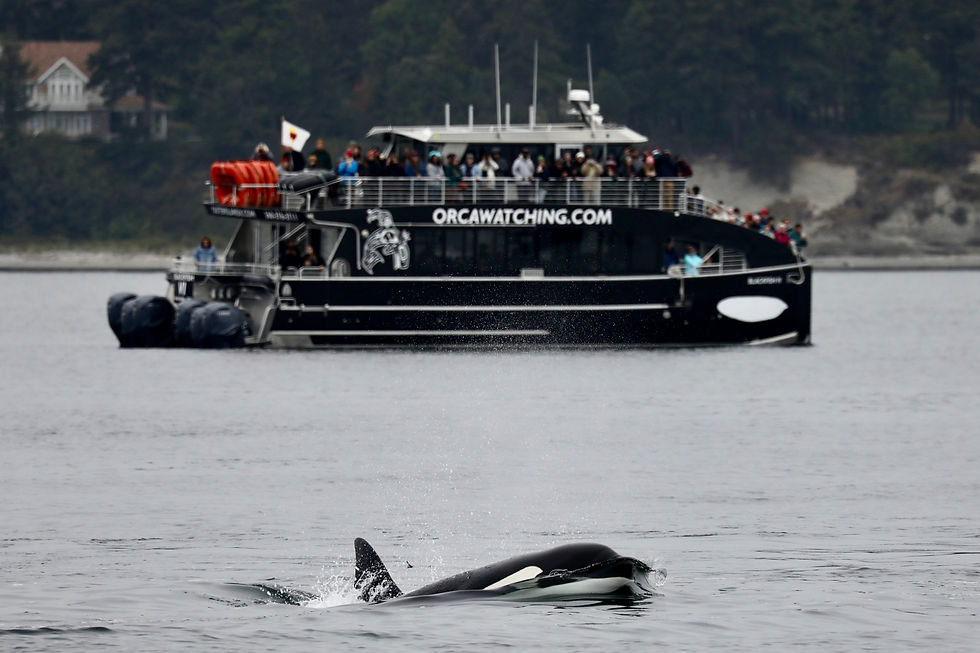
Calls, whistles, echolocation, social learning, and coordinated behavior reveal an animal adapted to life in a complex underwater environment.
Scientists have learned a great deal from decades of observation and acoustic research, but there is still much to understand.
For whale watchers, that's part of the appeal. You can observe what the animals are doing while recognizing that not every sound or movement has a simple translation.
FAQs
How do orcas communicate?
Orcas use pulsed calls, whistles, clicks, and physical behaviors to communicate and interact with their environment.
What is echolocation?
Echolocation involves producing clicks and interpreting returning echoes to gather information about prey, objects, and surroundings.
Are Bigg's killer whales quiet when hunting?
Bigg's killer whales are very quiet while searching for marine-mammal prey, which may reduce the chance of alerting animals capable of hearing them.
Does boat noise affect orcas?
Human-generated underwater noise can alter the acoustic environment orcas depend on, which is one reason responsible vessel operation around wildlife is important.
Can I hear orcas during a whale watching tour?
Possibly if suitable hydrophone equipment is available and conditions allow, but it shouldn't be expected on every tour.


Reviews on delta airlines reviews my recent experience was commendable, marked by their punctuality and attentive service. The cabin crew exhibited professionalism and courtesy, ensuring a comfortable journey throughout the flight. Additionally, the in-flight entertainment options were diverse and engaging, making the travel experience enjoyable. Overall, Delta Airlines demonstrated a commitment to quality air transport, and I would not hesitate to recommend their services to fellow travelers.