


How Scientists Identify Individual Orcas in the Salish Sea
How are orcas identified as individuals when they can look so similar at first glance?
Researchers use distinctive physical features, especially dorsal fins and saddle patches, along with photographs collected over time. These records allow scientists to recognize individual animals and learn about their families, movements, and life histories.
The same identification methods can make a whale watching encounter more meaningful by helping naturalists explain more about the individual orcas being observed.

Why Individual Identification Matters
Identifying individual orcas allows researchers to follow animals over many years.
Long-term records can help document:
Births and deaths
Family relationships
Movement patterns
Associations between whales
Injuries and physical changes
Population trends
Instead of simply recording that orcas were present, researchers can determine which known individuals were observed.
The Dorsal Fin
The dorsal fin is one of the most useful features for identification.
Shape
Dorsal fins vary in height, curvature, and overall profile. Adult males generally develop taller dorsal fins than females and younger animals.
Nicks and Notches
The trailing edge of the fin may contain distinctive nicks, notches, or irregularities. These features can help researchers recognize an individual in photographs.
Scars and Marks
Visible scars and other lasting marks can provide additional identification clues.
Researchers generally consider several characteristics together rather than relying on one feature.
The Saddle Patch
The saddle patch is the gray or whitish area immediately behind an orca's dorsal fin.
Its shape, pigmentation, and markings vary between individuals.
Researchers photograph these patterns and compare them with identification catalogs.
Combining saddle-patch characteristics with dorsal-fin shape and markings can make an individual recognizable across repeated encounters.
How Photo Identification Works

Photography is central to orca identification.
Researchers collect clear photographs showing useful identifying features and compare them with catalogs of known whales.
They may examine:
Dorsal-fin shape
Nicks and notches
Saddle-patch pattern
Pigmentation
Scars
Other distinctive markings
Multiple photographs can help confirm an identification when waves, lighting, distance, or viewing angle make individual features difficult to see.
Identification Records Change Over Time
An orca's appearance isn't completely static.
Calves grow, males develop taller dorsal fins as they mature, and animals may acquire new scars or markings.
Identification catalogs therefore require ongoing updates. New animals can be documented while changes to known individuals are recorded through repeated photography.
Family Relationships Provide More Clues
Researchers don't rely only on physical appearance.
Who an orca regularly travels with can provide additional context.
Repeated observations of animals together help researchers understand family relationships and social associations. For example, observations of a known female consistently travelling with a calf can contribute to understanding that calf's identity and family history.
Genetics and Acoustic Research
Photography is only one part of orca research.
Genetic analysis can help scientists investigate relationships and differences among killer whale populations. Carefully collected biological samples may provide information about ancestry and population structure that photographs cannot.
Researchers also study orca vocalizations. Different groups can have recognizable acoustic patterns, providing another source of information about the whales using an area.
These methods complement visual identification rather than replacing it.
How Bigg's Killer Whales Are Identified

Bigg's killer whales, also called transient killer whales, are identified using the same broad photo-identification methods.
Researchers examine dorsal fins, saddle patches, scars, and other distinguishing characteristics.
Long-term records help researchers understand which animals travel together and how different family groups move through the broader region.
For whale watchers, individual identification can transform "we saw orcas" into a more detailed encounter with known animals and family groups.
How Naturalists Identify Orcas on Tours
Experienced naturalists learn recognizable physical characteristics and may use identification resources to help determine which animals are present.
Identification isn't always possible.
An orca might be too far away, surface briefly, or present an angle that doesn't clearly show useful markings. Waves, lighting, and water spray can also make identification difficult.
A responsible naturalist shouldn't guess when the available evidence isn't sufficient.
What Individual Identification Reveals
Repeated identification helps researchers build a picture of orca lives.
It can reveal:
Family Associations
Which animals repeatedly travel together.
Movement
Where known individuals are documented over time.
Life History
Growth, calves, injuries, physical changes, and other events.
Population Trends
Which known animals continue to be documented and when new individuals appear.
Together, these observations contribute to a better understanding of killer whale populations.
Can Whale Watching Photos Help?
Sometimes photographs taken during wildlife encounters may contain useful identification information.
However, not every clear whale photograph is suitable for research. Researchers may need specific angles, dates, locations, image quality, or other information.
If you capture a useful identification photograph and want to contribute it, ask your operator whether there is an appropriate research or sighting-reporting program.
Identification Should Never Require Getting Too Close
Getting an identification photograph shouldn't require an unnecessarily close wildlife encounter.
Responsible whale watching operators follow applicable wildlife-viewing regulations and practices while observing orcas.
Guests should allow the captain to manage the vessel rather than requesting a closer approach for photography.
A long lens and patience are better tools than proximity.
Identifying Orcas on an Outer Island Tour
When an individual can be confidently identified, naturalists can add context about identifying characteristics, family associations, behavior, and what is known about the animals.
Outer Island Excursions focuses on the orcas currently moving through the region, including Bigg's killer whales.
Because orcas can travel more than 100 miles in a day, finding them involves tracking a constantly changing wildlife picture rather than travelling to one fixed "orca spot."
Why the Guaranteed Orca Tour Leaves in the Afternoon
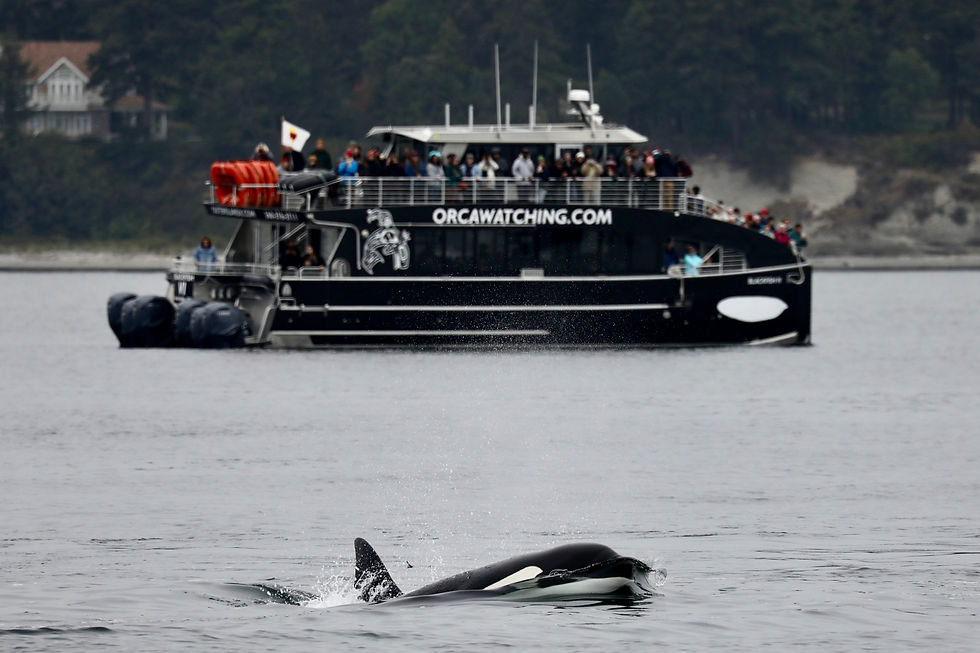
Outer Island Excursions' Guaranteed Orca Tour intentionally departs in the afternoon.
This isn't because orcas are inherently more active later in the day.
Orcas can travel more than 100 miles in a single day. By afternoon, crews have had more time to gather current information about where orcas have been sighted and how they have been moving.
Outer Island was the original company to offer an Orca-Specific Guarantee, making this tour especially relevant for visitors whose primary goal is seeing an orca.
Why Individual Identification Makes a Sighting Special
Recognizing an individual can change the experience.
Instead of seeing an anonymous dorsal fin, you're observing a known wild animal with distinctive characteristics, relationships, and history.
That's why photo identification is valuable both scientifically and educationally. Orca populations aren't simply numbers—they consist of individual animals living complex lives in a changing marine ecosystem.
FAQs
How are individual orcas identified?
Researchers use dorsal-fin shape, nicks and notches, saddle-patch patterns, scars, photographs, and repeated observations.
What is an orca's saddle patch?
The saddle patch is the gray or whitish area behind the dorsal fin. Its shape and pigmentation can help identify an individual.
Can Bigg's killer whales be identified individually?
Yes. Researchers identify Bigg's killer whales using dorsal fins, saddle patches, scars, and other distinguishing characteristics.
Can naturalists identify individual orcas during a tour?
Sometimes. Successful identification depends on distance, viewing angle, conditions, and how clearly identifying features can be observed.
Can my whale watching photos help researchers?
Potentially. Researchers may require particular image angles and supporting information. Ask your operator about appropriate ways to submit useful photographs.
Why does Outer Island's Guaranteed Orca Tour leave in the afternoon?
Orcas can travel more than 100 miles in a day. An afternoon departure gives crews more time to gather current information about where orcas have been sighted and how they have been moving.


Comments