


What Do Orca Behaviors Mean? Breaching, Spyhopping, Tail Slaps & More
Understanding orca behavior can make whale watching even more fascinating. A breach, spyhop, tail slap, or synchronized surfacing may provide clues about what an orca is doing, but interpreting behavior isn't always straightforward.
Researchers study behaviors over repeated observations and consider the context surrounding them. The same action may have different functions in different situations.
Here's a guide to some of the orca behaviors you may encounter in the Salish Sea.

Breaching
What Is Breaching?
A breach occurs when an orca propels much or all of its body out of the water before landing back at the surface.
It's one of the most dramatic behaviours to witness, but it shouldn't be expected on every whale watching trip.
Why Do Orcas Breach?
There isn't one confirmed explanation that applies to every breach.
Researchers have considered several possible functions, including:
Communication
Social interaction
Play
Display
Physical activity
Context matters. A breach occurring during an active social interaction may not serve the same function as one occurring in another situation.
Rather than assuming exactly what an orca "means," naturalists look at what the animal and surrounding whales are doing.
Spyhopping

What Is a Spyhop?
During a spyhop, an orca rises vertically and exposes its head above the surface.
The position gives the whale an opportunity to see above water.
Why Do Orcas Spyhop?
Spyhopping is generally associated with visually examining the surroundings.
What the animal is looking at, however, isn't always possible to determine.
An orca may spyhop when boats, wildlife, shorelines, or other activity are nearby, but observers should be careful about assigning human motivations such as curiosity without enough evidence.
It's better to describe what you can see than assume what the animal is thinking.
Tail Slaps
A tail slap, sometimes called lobtailing, occurs when an orca strikes the water's surface with its tail.
The impact can create an impressive splash and sound.
Tail slapping may occur during social activity, hunting, play, or other situations. Researchers consider the surrounding behavior when interpreting what a particular slap might represent.
A tail slap isn't automatically a warning or a sign that an animal is angry.
Pectoral Fin Slaps
Orcas may also slap the surface with a pectoral fin.
Like tail slaps, these surface-active behaviors can occur in different contexts.
They may be associated with communication or social activity, but it's important not to assign one universal meaning to every occurrence.
Fluking and Diving
Orcas regularly disappear beneath the surface as they travel, forage, socialize, and explore their surroundings.
Sometimes the tail flukes become visible as an animal dives, although dramatic fluke-up dives are more commonly associated with species such as humpback whales.
The length and direction of a dive can vary considerably.
Rather than relying on a fixed "orca dive time," watch where the animals were travelling and listen to the naturalist for clues about where they might surface next.
Rolling at the Surface
An orca may roll onto its side or back, sometimes exposing part of its underside or pectoral fins.
Rolling can occur during social interactions, play, or other activity.
As with many orca behaviors, the surrounding context matters more than the action by itself.
Resting Behavior
Not every orca encounter is highly active.
Orcas also need to rest.
During quieter periods, animals may travel slowly and remain close to other members of their group. Surface activity may appear much less dramatic than during hunting or social behavior.
Quiet behavior is still natural behavior and can provide an interesting look at how orcas spend their time.
Hunting Behavior
Bigg's killer whales hunt marine mammals such as seals, sea lions, and porpoises.
Hunting can involve coordinated movement among multiple whales, sudden changes in speed, longer periods underwater, and complex positioning.
Not every hunt looks the same, and much of the activity can occur below the surface.
Sometimes passengers see only a few clues that a hunt is occurring. At other times, the activity may be much more visible.
Social and Family Behavior
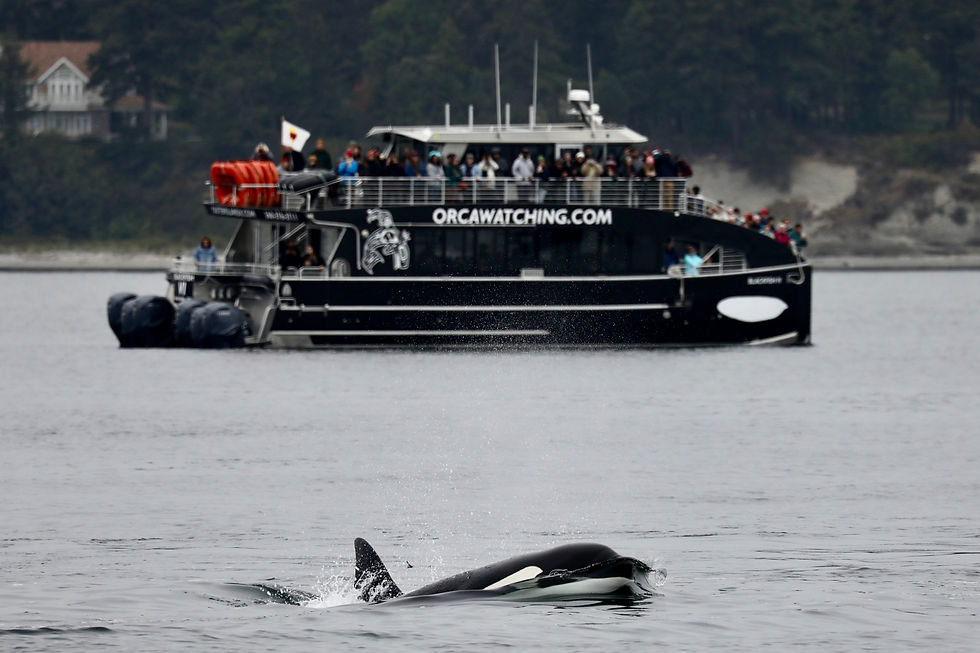
Orcas have strong social relationships, and watching multiple animals together can reveal some of the most interesting behavior of a tour.
Synchronized Surfacing
Two or more whales may surface close together or appear to coordinate their movements.
Calves and Adults
Young orcas often travel close to adults. Observing the spacing and movement of a group can provide clues about family associations.
Physical Contact
Orcas may make physical contact during social interactions.
Naturalists consider the identities of the whales and the broader context when explaining what guests are observing.
Play Behavior
Orcas sometimes interact with objects such as kelp or engage in energetic activity with other whales.
Young animals may chase, roll, splash, or interact with one another.
Researchers study play because it can provide insight into social development, learning, and behavior.
Still, observers should avoid interpreting every energetic movement as play without considering the surrounding activity.
Communication
Much of orca communication happens underwater.
Killer whales can produce calls, whistles, and echolocation clicks. Researchers study these sounds to learn more about communication, group relationships, movement, and foraging.
From a tour boat, passengers may not hear this underwater activity directly unless appropriate listening equipment is being used.
Surface behaviors such as breaching and slapping may also have communicative functions, although their exact meaning can vary.
Individual Orcas Behave Differently
Not every orca behaves the same way.
Age, social context, activity, family relationships, and individual differences can all influence what observers see.
This is one reason naturalists shouldn't claim that every breach, spyhop, or tail slap has one exact translation.
Orca behavior is complex.
What Will You Actually See on a Tour?
The most common sight may simply be orcas surfacing to breathe as they travel through the Salish Sea.
You might also observe:
Group surfacing
Direction changes
Diving
Social interactions
Hunting activity
Tail or pectoral slaps
Rolling
Spyhopping
Breaching
The more dramatic behaviors are exciting, but they're never guaranteed.
Wild orcas determine what happens during the encounter.
Responsible Behavior Observation

A responsible whale watching tour observes natural behavior rather than trying to create it.
Guests shouldn't ask a captain to chase an animal, get unnecessarily close, make noise to attract whales, or maneuver the boat in an attempt to produce a dramatic photograph.
Outer Island Excursions follows applicable wildlife-viewing regulations and responsible operating practices.
The goal is to observe what the animals naturally choose to do.
How Naturalists Add Context
A knowledgeable naturalist can help explain what you're seeing without pretending to know exactly what an animal is thinking.
They may consider:
Which animals are present
How the group is moving
Whether the whales appear to be hunting or socializing
Which behaviors happened immediately before and afterward
Environmental conditions
That context can turn a few seconds of surface activity into a much more educational encounter.
Finding Orcas in the Salish Sea
Before you can observe orca behavior, you first have to find the animals.
Orcas can travel more than 100 miles in a single day, so their location can change considerably.
That's why Outer Island Excursions' Guaranteed Orca Tour intentionally departs in the afternoon. The later departure provides more time for current sighting information to develop before crews begin their search.
Outer Island was the original company to offer an Orca-Specific Guarantee, making the tour especially relevant for visitors whose main goal is seeing an orca.
FAQs
What does it mean when an orca breaches?
There isn't one universal meaning. Breaching may be associated with communication, social interaction, play, or other activity. Context is important.
What does spyhopping mean?
Spyhopping allows an orca to raise its head above the surface and visually examine its surroundings.
Why do orcas slap their tails?
Tail slaps can occur during several types of activity, including social interactions and hunting. A slap shouldn't automatically be interpreted as anger or aggression.
Will I see an orca breach on a whale watching tour?
Possibly, but breaches and other dramatic behaviors aren't guaranteed. Regular surfacing, travelling, diving, and group interactions are more typical observations.
Can naturalists predict what an orca will do?
Naturalists can interpret context and recognize behavioral patterns, but wild orcas remain unpredictable.
Why does Outer Island's Guaranteed Orca Tour leave in the afternoon?
Orcas can travel more than 100 miles in a day. An afternoon departure gives crews more time to gather current information about where orcas have been sighted and how they are moving.


Comments