


How Long Can Whales Stay Underwater? Breathing and Dive Times Explained
How long can whales stay underwater? The answer depends on the species, what the whale is doing, and how deep it needs to dive.
Some whales surface after just a few minutes, while specialized deep-diving species can remain underwater for more than an hour.
For visitors whale watching in Washington's Salish Sea, understanding these patterns helps explain why whales sometimes disappear beneath the surface before returning.
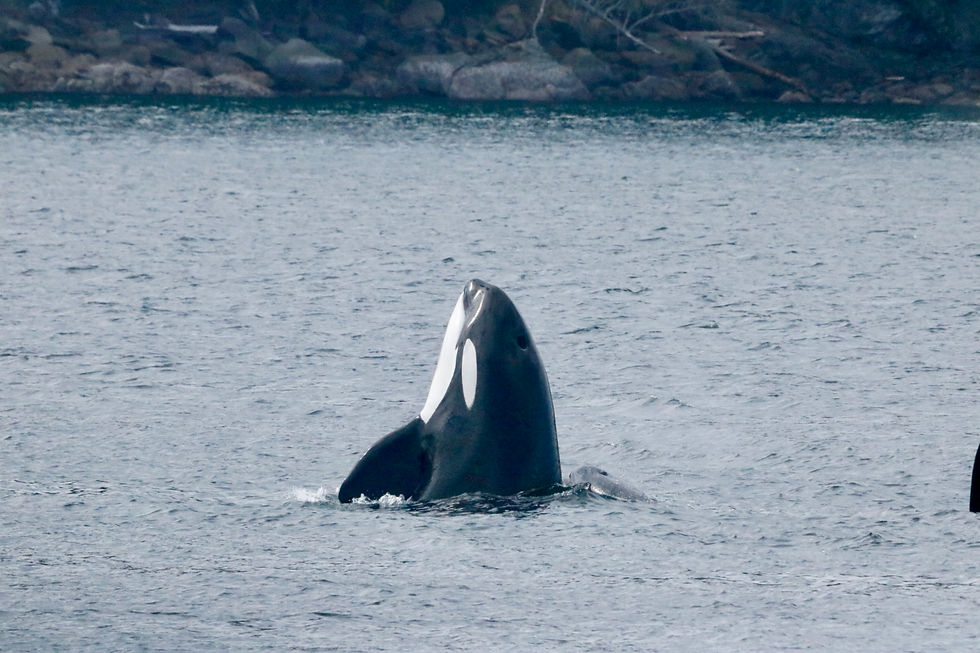
How Long Can Different Whales Stay Underwater?
Whales have different diving abilities based on their physiology and feeding strategies.
The following are approximate ranges, not fixed limits.
Whale Species | Common Dive Duration |
Orcas (killer whales) | Often a few minutes; some dives last 10 minutes or longer |
Humpback whales | Commonly 5–15 minutes during deeper dives |
Gray whales | Often several minutes, depending on feeding activity |
Minke whales | Frequently a few minutes |
Sperm whales | Commonly around 45–60 minutes during deep foraging dives |
Blue whales | Often several minutes to around 20 minutes |
Fin whales | Variable, frequently several minutes |
Individual dives may be shorter or longer depending on the circumstances.
How Long Can Orcas Stay Underwater?
Orcas are air-breathing marine mammals that regularly surface between dives.
Many dives last only a few minutes, although longer dives are possible.
Bigg's killer whales, also called transient killer whales, travel through the Salish Sea hunting marine mammals such as seals, sea lions, and porpoises.
Their dive patterns can change while travelling, searching for prey, hunting, or interacting socially.
A whale disappearing underwater doesn't necessarily mean it has left the area.
How Long Can Humpback Whales Stay Underwater?
Humpbacks frequently remain submerged for several minutes, with deeper feeding dives sometimes lasting around 5–15 minutes or longer.
Dive duration depends on prey location and activity.
When a humpback raises its tail flukes before descending, it may be beginning a deeper dive.
However, fluking doesn't provide an exact prediction of how long the whale will remain underwater.
What About Gray and Minke Whales?
Gray whales often make repeated dives while feeding or travelling.
Their dive duration varies with water depth and activity.
Minke whales can be especially challenging to observe because they may surface briefly and disappear again without showing much of their bodies.
These patterns make patience an important part of whale watching.
Which Whales Can Stay Underwater the Longest?
Deep-diving whales have remarkable breath-holding abilities.
Sperm whales commonly undertake lengthy foraging dives while searching for prey far below the surface.
Cuvier's beaked whales are particularly well known for exceptional diving endurance.
Researchers have documented individual dives lasting more than three hours.
These extraordinary performances aren't representative of the whales typically encountered on Salish Sea tours.
How Do Whales Hold Their Breath?

Whales have specialized adaptations that allow them to remain underwater much longer than most land mammals.
Oxygen Storage
Whales store oxygen in their blood and muscles.
Their muscles contain myoglobin, a protein that helps store oxygen for use during dives.
Slower Heart Rate
During diving, whales can reduce their heart rate and alter blood circulation.
These responses help conserve oxygen for vital organs.
Efficient Oxygen Use
Whales can adjust how their bodies use oxygen while submerged.
Their physiology supports extended periods without breathing, particularly in species adapted for deep diving.
Pressure Adaptations
Deep-diving marine mammals have respiratory adaptations that help them manage increasing pressure.
Changes in lung and airway function can reduce gas exchange at depth, although diving physiology is more complex than simply preventing decompression sickness.
How Do Whales Breathe?

Whales breathe air through blowholes located on top of their heads.
When a whale surfaces, it exhales and inhales before submerging again.
The visible blow is primarily warm breath and water vapor condensing in cooler air, sometimes accompanied by surface spray.
Different species have recognizable blow shapes, although wind and viewing angle can affect their appearance.
Unlike fish, whales cannot extract oxygen from water through gills.
They must return to the surface to breathe.
Do Whales Breathe While Sleeping?
Whales must continue surfacing to breathe even during rest.
Some cetaceans exhibit unihemispheric sleep, in which one brain hemisphere shows sleep-related activity while the other remains more alert.
Sleep and resting patterns vary among species, and scientists continue studying how large whales manage rest while maintaining breathing and awareness.
What Affects Whale Dive Times?
Several factors influence how long a whale remains submerged.
Species: Different whales have different diving adaptations.
Feeding behavior: Prey depth and hunting strategy influence dive duration.
Activity: Travelling, resting, and social interactions can involve different breathing patterns.
Age and physical condition: Diving ability can vary between individuals.
Environmental conditions: Water depth, prey distribution, and disturbance may affect behavior.
A long dive isn't automatically evidence that a whale is stressed or hunting.
What Does Fluking Mean?
Fluking occurs when a whale lifts its tail above the surface before diving.
Humpback whales are particularly well known for this behavior.
Their tail flukes have distinctive markings that researchers use to identify individuals.
Seeing the tail rise can suggest a deeper dive is beginning, but not every dive includes visible fluking.
Can You Predict Where a Whale Will Surface?
Not reliably.
Whales may continue travelling underwater, change direction, or remain submerged longer than expected.
Experienced captains observe movement patterns and current sighting information, but surfacing locations remain unpredictable.
Responsible operators maintain appropriate viewing distances rather than chasing whales toward a predicted surfacing point.
What Dive Times Mean for Whale Watching
Whales aren't continuously visible throughout an encounter.
You may see several breaths followed by a longer period underwater.
A naturalist can help explain the difference between travelling, diving, resting, and feeding behavior when observations support those interpretations.
Knowing that whales naturally spend time underwater makes the waiting part of the experience rather than a sign that the encounter is over.
Experience Whale Watching with Outer Island Excursions

Outer Island Excursions offers naturalist-led whale watching tours in Washington's Salish Sea.
For visitors whose main priority is orcas, the company offers a Guaranteed Orca Tour.
Outer Island Excursions was the original company to offer an Orca-Specific Guarantee.
The tour intentionally departs in the afternoon because orcas can travel more than 100 miles in a single day.
This gives crews more time to gather current information about where orcas have been sighted and how they're moving.
Explore Outer Island's whale watching tours to learn more.
FAQs
How long can orcas stay underwater?
Orcas commonly dive for a few minutes, although some dives can last 10 minutes or longer depending on their activity.
How long can humpback whales hold their breath?
Humpbacks often remain submerged for several minutes, with deeper dives commonly lasting around 5–15 minutes or longer.
Which whale holds its breath the longest?
Cuvier's beaked whales are among the most exceptional breath-holding divers, with documented dives lasting more than three hours.
Can whales drown?
Yes. Whales breathe air and can drown if they cannot reach the surface, including in some entanglement situations.
Why do whales disappear during a tour?
Whales naturally spend time underwater while travelling, feeding, or resting. Their next surfacing location and timing aren't always predictable.


Hi friends! This is an interesting article—I really enjoyed reading it. I actually came here to ask: how can players find previously viewed games on a platform? Do you have any advice? I’d be very grateful!