


The Sounders: Gray Whales of the Salish Sea
- Outer Island Excursions

- 5 hours ago
- 4 min read
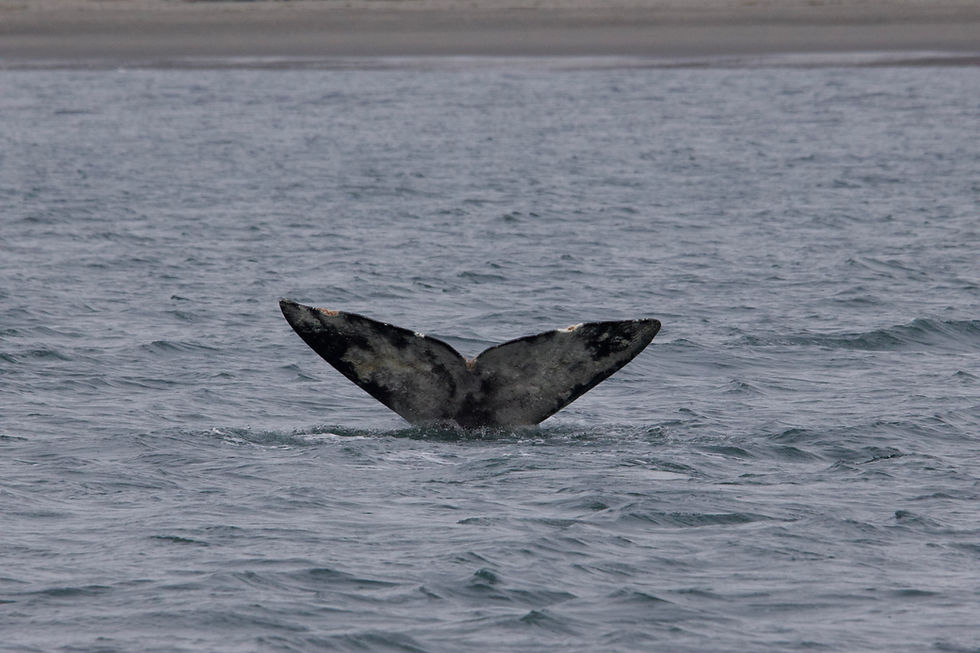
Spring in Washington State welcomes warmer weather, fresh growth, and a special group of gray whales. Known locally as the North Puget Sound Sounders for their regular appearances in the Puget Sound, these gray whales represent a unique part of the gray whale population.
The Gray Whale Migration
Gray whales undertake one of the longest migrations of any mammal on Earth, traveling 10,000-12,000 miles round trip between Baja California, Mexico and the Arctic. During the winter months, gray whales gather in protected Mexican lagoons to breed and give birth. As winter comes to an end, they begin their long journey north toward the rich feeding waters of the Arctic. Gray whales, like most baleen whales, only eat for a few months out of the year, consuming up to one ton of food per day during feeding season.
Out of the up to 14,000 Eastern North Pacific gray whales, most complete this full migration route each year. However, a small subgroup, known as the Pacific Coast Feeding Group (PCFG) shortens the journey. This group of about two hundred whales feed in the waters between northern California and British Columbia rather than continuing to the Arctic.

Within the PCFG population is an even smaller collection of whales–the Sounders. First studied in the Puget Sound region in the 1990s, this group of gray whales originally consisted of only a handful of whales. Over time, individuals returned to feed in local waters, and the numbers slowly increased. The Sounders typically arrive in the Salish Sea in February and leave by May, continuing feeding elsewhere along the North American Coast. As of 2025, thirteen Sounders visited the Salish Sea during the Spring feeding Season.
Environmental Challenges for Gray Whales
Unlike many baleen whales that feed in deep, open water, gray whales are bottom feeders, preferring shallow coastal habitats. Capable of holding their breath for over thirty minutes, gray whales roll onto their side and scoop sediment from the seafloor, filtering small crustaceans through their baleen plates, with ghost shrimp in particular their main source of food here in the Salish Sea.
Researchers believe the Sounders originally discovered the Salish Sea during a period of food scarcity. The whales, too hungry and frail to continue to their Arctic feeding grounds, essentially found the Salish Sea by accident. The inland sea is home to a variety of crustaceans, particularly ghost shrimp, a favorite delicacy for gray whales.

In recent years, hundreds of gray whales have washed ashore the West Coast of North America in what scientists refer to as an Unusual Mortality Event (UME). Many of these whales showed signs of malnutrition, suggesting that changing ocean conditions, including climate change, disease, and shifts in prey availability.
Grey whales are now known almost exclusively as a Pacific Ocean species, but that wasn’t always the case. The species once also called the Atlantic home. The commercial whaling era of the 1800s changed that, wiping out the Atlantic population completely. While Atlantic grey whales are now considered extinct, in recent years rare sightings have placed greys in the Atlantic. It’s suspected these whales are displaced Pacific grey whales wandering far outside their normal range, perhaps travelling across the north pole as the sea ice continues to melt and allow travel to the Atlantic. Sightings in recent years include an individual seen in Florida, as well individuals in the Mediterranean and off the coast of Namibia.
Although the Eastern North Pacific grey whale was removed from the endangered species list in 1994, grey whales still face many challenges. Lack of food and pollution have brought their numbers down significantly, with an estimated 14,000 left. The Western North Pacific gray whale population, found off the coast of Russia, remains critically endangered, with numbers in the low hundreds.
Spring Whale Watching in the Salish Sea

The Sounders, like all whales that visit the Salish Sea, are photo-identified by distinctive markings unique to the individual. Because many of these whales return to the same feeding areas each year, researchers and naturalists recognize and record specific individuals. The Sounders are frequently among the first whales spotted on whale watching tours as the season begins in March.
The Salish Sea provides an ideal location for whale watching and scientific research. Sheltered from the open Pacific by Vancouver Island, these protected inland waters offer calmer conditions for biologists and naturalists eager to see gray whales in their natural habitat.
For wildlife enthusiasts visiting Washington State, the arrival of the Sounders each March marks the start of the spring whale watching season. Because these whales spend months feeding in the coastal waters, the Salish Sea is one of the best places in the world to see gray whales in their natural habitat.



Comments